A battle over the dominance of the West Country, two sides of Bristol split into red and blue and north and south. The south being dominated by Bristol City and the north by Bristol Rovers. It is one of the most fierce derbies in the UK, this is the Bristol Derby.
Bristol City wins- 45
Bristol Rovers wins- 29
Draws- 33
How the derby was formed?
The first meeting of this fierce rivalry took place on 22nd September 1894 when the newly formed Bristol Sound End, who were later to be called Bristol City hosted a friendly with neighbours Eastville Rovers who were then later named Bristol Rovers at their ground at St John’s Lane in Bedminster.
Bristol South End won 2-1 and after several more friendlies, the teams finally had their first competitive meeting when they were drawn together in the 1895-96 Gloucestershire Cup. The game was played at Ridgeway ground, the home of Eastville Rovers and with the home advantage the North Bristol side won 4-0.
This was the first match of a rivalry which was later to be known as one of the fiercest in Britain, a battle of the superiority of the West Country.
The rivalry was formed from the two sides of Bristol splitting into Red and Blue and South and North. Bristol City being in the South and Bristol Rovers being in the North.
The South West is home to no other teams in the region close enough to Bristol City and Bristol Rovers so it’s hard to take the attention away from both teams. Other football clubs in the region include Swindon, Cheltenham and Yeovil, all teams that haven’t made a lasting effect with tension levels relatively low, the level of hatred between City and Rovers puts them at the top of rivalries in the South West and in the top 10 in the UK.
However, both Bristol clubs have previously clashed with Swindon Town on numerous occasions, most recently during Bristol City’s promotion during the 2014/15 League One campaign and Bristol Rovers clash with them last year after meeting on the Edinburgh to Bristol Temple Meads service after Rovers played Barnsley and Swindon played Notts County which led to both sets of fans being placed on different services to avoid continuing trouble.
The reason it’s considered as one of the fiercest is due to one factor, the regularity of the derby. Due to both teams being a league apart, it prevents the two teams meeting in the league.
Therefore, it’s only available through the Cup and this isn’t a regular fixture that happens every few years or so, the last meeting was back in 2013. Therefore, the tensions built up on the night of the derby have been building up for years and therefore, violent conduct isn’t surprising.
If the two teams met more regularly, there wouldn’t be as much arrests as it would act as a dampener to tensions as there’s multiple occasions for teams to gain the bragging rights, in this derby there isn’t. The difference is years, not months. It’s all about two teams competing for superiority over the other, the dominance of Bristol.
A bragging right that is currently placed in the South of Bristol with the success Bristol City have had in recent years and with the recent redevelopment of Ashton Gate, Bristol City are currently planning for a future in the top flight. The successor of this derby is still unpredictable with Bristol City still unable to consistently shake off Bristol Rovers even when there’s a difference in player and coaching quality. That’s what makes the Bristol Derby so interesting, results are always tight and in the majority of fixtures, it’s only one goal which separates the winner from the loser, the last fixture where there was a clear winner was back in 1992 when Bristol Rovers won 4-0, the rest leading up to the most recent in 2013 have only been separated by one or two goals.
Famous nicknames
Bristol Rovers are known as the Gas, a nickname formed back in the Eastville Rovers days, based on the large gasworks situated outside the ground resulting in a strong odour moving over the stadium on matchdays which resulted in Bristol South End fans calling their neighbours the Gas or Gas heads. It was firstly seen as an insult to Rovers fans but over the years, the gas adopted the name slowly.
“The Gas, the Gas, you’ll never ger rid of the Gas” echoed through Ashton Gate when they equalised in the latest encounter which City went on to win in 2013.
During the 60’s and 70’s when football violence was at its peak across the country, the Bristol City centre was perfect place for running battles between the early skinheads and “greasers”. City’s East End was recognised for the smartly dressed Skinheads while the Tote End at Rovers was home to the town’s greasers. Around the country, every club had skinheads, but Rovers specifically had a large following of greasers who were known as the rougher fans which coincided with the nickname old Bristol City boss Steve Cotterill gave them, “Ragbag Rovers” which they later seized onto.
The latest meeting between both clubs was in the Johnstone’s Paint Trophy 1st Round, the match was played on the 4th September 2013 at Bristol City’s home of Ashton Gate in front of a crowd of 17,888, nearly 2,500 who were Bristol Rovers fans.
Man-of-the-match Jay Emmanuel Thomas put the hosts in front after a 25-yard left footed screamer in the 12th minute. However, it was Bristol Rovers who started the second half the better team and it showed when Mark McCrystal headed home Lee Brown’s freekick in the 59th minute to equalise.
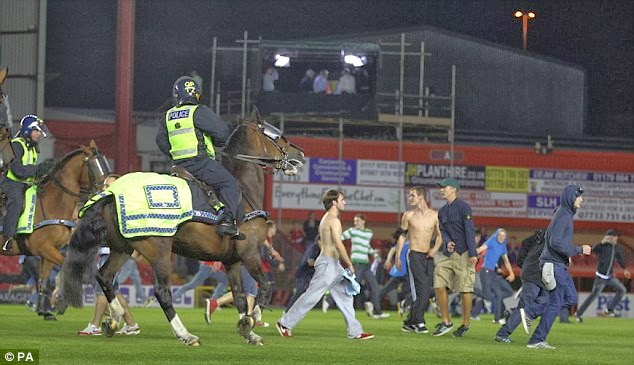
Though, it was Bristol born teenager Joe Bryan who was the hero on the night securing Bristol City with the bragging rights after his clinical finish in the 76th minute. The full-time whistle blew and instantly, there was a surge of Bristol City fans charging towards the corner of the East End where Rovers fans were situated. Police were on standby and quickly intervened blocking the City fans, and police horses were called in to push out the City fans back towards the other side of the pitch and into the home stands.
There were over 50 arrests from both sides and three police officers had to receive medical treatment after fighting was converted from the pitch to outside the stadium in the KFC car park. Riot police were called in to restore order and several failed attempts saw fans disperse over the Ashton area with reports of fighting near Greville Smyth Park, near to Ashton Gate.
It was the first Bristol derby in seven years and tensions were high from the outset, but police didn’t expect this level of trouble as it continued throughout the night lasting for several hours in numerous locations over South Bristol.
Seven Bristol City fans were sentenced at Bristol Crown Court for participating in the fighting that occurred on the night, one fan was banned from attending all matches in Britain for six years due to his history of violence at football, previously being given a three-year ban for football related trouble, the defendant was also given a 19-month suspended jail term. While the other six defendants got three-year football banning orders and were prohibited within 1,000 yards of either club’s stadium during matchdays.
Judge Graham Hume Jones told all the defendants “Some of you are aged 40 to 56 and should know better than to behave like this”. The court heard several other details surrounding the events which led up to the game when it heard that around 200 Bristol City fans gathered outside a local pub three hours before kick-off, while over 400 Bristol Rovers fans gathered at a neutral pub which directed police to the area to keep them separated and to prevent trouble between the two rival fans.
Details were also covered on when a taxi containing Bristol Rovers fans arrived outside a pub and was immediately shelled with glasses and bricks and when police horses and dog teams were called in to contain the trouble, one officer was hit in the face with a pint glass and another had a glass smashed over his helmet.
There have also been various other incidents where the two sides have clashed away from the derby with the most recent incident being after England beat Panama 6-1 at the World Cup last year. Several Bristol City and Bristol Rovers fans clashed outside a bar in Park Street, scenes which included punches being exchanged along with tables, shop signs and cones being thrown with one set of fans chanting ‘GHS’, an abbreviation for ‘Gas Hit Squad’ a Bristol Rovers hooligan group.
I spoke with Bristol City fan Chris who described his favourite moments as a City fan against Rovers including his first derby day as a young boy.
“I was a mascot for the Bristol derby in January 1996, it went horribly wrong because the club let it fill up through the turnstiles, and when people arrived with pre-paid tickets 10 minutes before kick-off, they locked the gates.
I was obvious to this in the ground until fans broke in through the referee’s toilet and ran out through the tunnel into the ground. I remember seeing stewards holding a gate shut that hundreds of fans were pushing against to try and get in.
After the Rovers equaliser, a few hundred Bristol City fans ran onto the pitch confronting the Rovers players which then after play resumed and the final whistle blew, all happened again when around 200 City fans ran after the Rovers players as they were entering the tunnel. By comparison to that Jack Grealish incident with the Birmingham fan, this saw 200 odd chase the Rovers team from the pitch and brawl with them in the tunnel. Nutters.”
What was your favourite Bristol derby moment?
“The JET goal was special, to be honest they’ve had better moments in the derby in my life which always seem to be late winners or equalisers. I always remember the joy of beating them 2-0 at home in spring 98. Bell penalty, and Goater from a Murray cross. I was 16 and me and my mates used to put a pound in to guess the first scorer. I won, we won, and we went on to get promotion, it was a great year. Also, nothing tops Rovers slipping out of the league in 2014, that’s the closest I’ve come to caring what they were up to and was listening to the last game of the season on the radio praying that they wouldn’t get an equaliser that would save their skin, Mind the gap”.
Bristol Rovers fan Josh then gave me his insight into his favourite Bristol Derby moment:
“My favourite derby day as a Bristol Rovers fan was under the lights at the Memorial Stadium in February 2007 in the second leg of the Football League Trophy semi-final in which the winner had a place at Wembley.
“The first leg had finished 0-0 at Ashton Gate therefore tensions and nerves were equally as high.
“Arriving at the game being greeted by the lines of regimented police horses and hordes of riot police setting the tone of the evening, it was ill fought and violent.
“The rivalry between us two sides has always been fierce and marred with violence and storylines.
“The game itself was tense and both sides gave little away, the game was littered with few chances and a single goal was certainly going to settle it. The feel of the home crowd was that if a chance fell, we could write a new underdog story and therefore have the bragging rights.
“Goodnight Irene echoing around the ground, my hairs stood up, there is nothing like a Bristol Derby. Both sets of fans exchanging songs with pure hatred for another, no love lost even in the absence of a derby for many years it’s soon remembered.
“Then in the 65th minute when a certain Rickie Lambert not only propelled his career into action but set the north side of Bristol into pure disbelief. A moment of silence followed by 10,000 cheers, that feeling I’ll never forget. The Blackburn End filled to the bouncing around making the cobbles shake.
“As sweet a volley you will see, it could have travelled back to south Bristol with the city if that net wasn’t there, nobody could have saved that.
30 minutes of holding on and head in hands moments followed by the biggest sense of relief we’d done it, we’d beaten City for the first time since 2000 and the bragging rights were ours. Little old rag bag Rovers had beaten their bitter rivals and were off to Wembley.
Fans spilled onto the pitch and towards the away end taunting the result to the stunned away end, police horses galloped onto the pitch and once again the sound of Goodnight Irene filled the North Bristol skyline, every home fan stood hands in the air bellowing the famous song, reality didn’t kick in until the drive home.
I have every faith that night spurred us on to our playoff promotion that season, that’s how important a Bristol Derby is.”
Photos and videos included in my report were sourced from Josh Palmer
 footballrivalries.video.blog