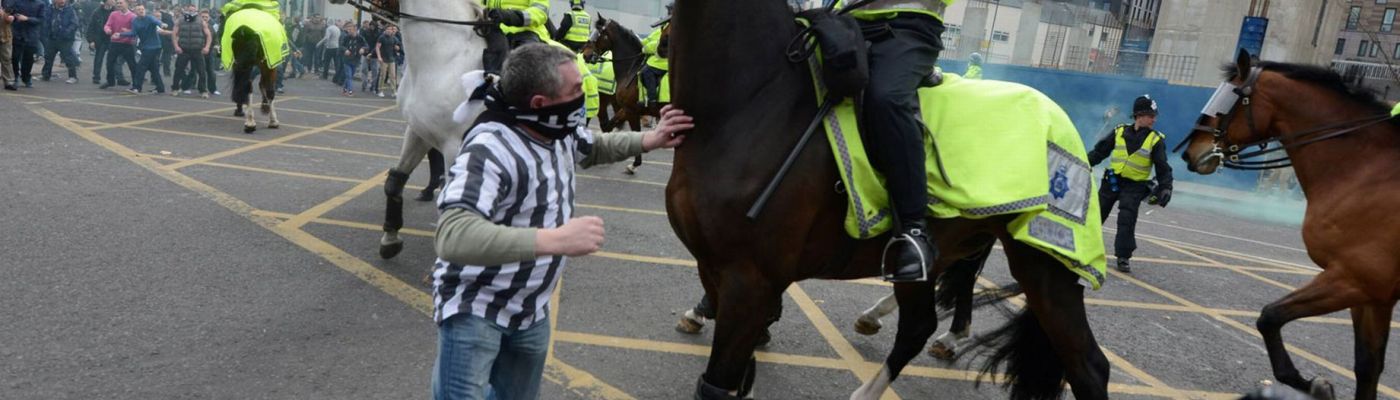
The feud between the two cities dates to the English civil war, when Newcastle stayed loyal to the crown and Sunderland joined the Parliamentary rebellion.
In the 1600s, King Charles I granted East of England Coal Trade Rights to Newcastle’s merchants, this decision ended up crippling the people of Sunderland.
When civil war broke out, it was inevitable they would be on opposing sides, culminating in the battle of Boldon Hill. A war between the loyalist army from Newcastle and County Durham against an anti-monarchist Sunderland and Scottish army.
Newcastle lost and the city was colonised by an army from Scotland, which had been supported by troops from Sunderland.
This bloody conflict is generally regarded as the moment the rivalry between two neighbouring towns turned hostile. Some of the great derbies are rather based on the difference between the two sets of fans particularly the classes for example Lyon v St Etienne was formed on St Etienne’s blue-collar working class against Lyon’s white-collar admin workers.
But over time, this reasoning for a derby soon fades away as it isn’t as deep and meaningful.
The Tyne-Wear derby is in our top 10 rivalries in the UK due to the short regional conflict shared between the two teams particularly when it preludes football by 226 years, a conflict that has divided Sunderland and Newcastle for more than three centuries unlike most other rivalries, the difference between the both clubs dates back to fighting based on the need to live and feed each other’s families and benefit city living.
It holds a very similar meaning to The Old Firm derby in the sense as it goes beyond work classes, it’s religion. Celtic’s origins firmly embedded in Irish Catholicism and Ranger’s origins firmly embedded in Protestant beliefs, the divide known as sectarianism which has engulfed Scotland for years in a war leading to many deaths from both sides.
Another reason why this rivalry is so fierce, and tensions are so high is that in the 1600s, King Charles I had consistently awarded the East of England Coal Trade Rights to Newcastle’s traders, making the Wearside coal merchants redundant.
This decision led to many people dying because of it. The coal and ships industry were Sunderland’s raison d’etre.
Another major part of history which involved both sides clashing again was in 1642, when the English Civil War started, and Newcastle, with good reason, supported the Crown, Sunderland, however due to the trading inequalities, sided with Cromwell’s Parliamentarians, and the separation began. It became a conflict between Sunderland’s socialist republicanism, against Newcastle’s loyalist self-interest.
One of the worst related football violence incidents – 18th March 2000
It was an event where over 70 Sunderland and Newcastle hooligans took part in what is condemned to be one of the worst related football violence incidents ever in Britain.
The sides weren’t even playing each other, as Sunderland were playing at home to Middlesbrough and for safety reasons, Newcastle were scheduled to play away. However, on a Tyneside street called Ferry Mews, over 70 fans who were seen to be your fathers, uncles and brothers met with knifes, bricks and bats.
The fighting lasted around five minutes at North Shields passenger ferry landing point, the two groups named the ‘Seaburn Casuals’ and the ‘Newcastle Gremlins’. Weapons were left lying around, pools of blood were visible, and one man was permanently brain damaged. Kingsley Hyland OBE, a special case work lawyer for the Crown Prosecution Service stated: “It was violence and disorder on a massive scale.”
At the resulting trial, the jury heard it compared to a “scene from the film Braveheart”. Many of those who were involved were respectable figures in the public, among them was a former Royal Navy diver, a soldier and a tax inspector.
Some of the men involved weren’t even from the Tyneside area as many had also travelled from Manchester to side with the Seaburn Casuals (Sunderland).
However, other men present had previous convictions for football related violence with club and country, a fierce reputation at England matches, and several of the men were well known to police “spotters”, officers who are known to film trouble makers at football grounds across the country.
One man suffered brain damage from the incident and dozens were arrested while police tried to identify the ring leaders of this prearranged fight after seizing the mobile phones of the fans arrested getting off the ferry at South Shields.
Head to head
As It stands in the Tyne Wear derby, Sunderland have seen the most success with 54 wins and 49 draws to Newcastle’s 53 wins.
Their first meeting was on the 24th December 1898 where Newcastle won 3-2 in a game played at Roker Park in front of around 25,000 fans in the English Division One.
Their most recent fixture was on the 8th January 2019 where Sunderland won 4-0 in a game played at the Stadium of Light in front of 16,654 fans in the Football League Trophy 3rd round which involved Sunderland’s first team and Newcastle’s under 23’s, a rule for all Premiership and Championship clubs competing.
This was the closest both teams got to a Tyne-Wear derby with the last time both teams playing against each other being on the 20th March 2016 in the Premier League, the game ended 1-1.
However, the tension could still be felt when most Newcastle fans tried to sell out the whole stadium, however, due to the limited allocation given from Sunderland, this couldn’t be done.
It was a must win for both teams even if it involved Newcastle’s u21’s, it was just as important as a first team clash, and Newcastle fans wouldn’t have let it go if they were victors, an even more sweet sight if their youngsters had managed to overturn an experienced Sunderland side. However, the experience seemed to be the deciding factor as the home side were comfortable winners winning 4-0.
The Tyne Wear’s top goal scorer is Sunderland’s George Holley, an inside forward who spent much of his career at the Black Cats helping them claim the Football League title in 1913. In the same year, he also helped them get to the FA Cup final seeing defeat to Aston Villa after losing 1-0.
The largest victory from a side in a Tyne Wear derby was back in 1908 when Sunderland won 9-1, the exact season when Newcastle won the league making Sunderland’s win a little better for Sunderland fans after seeing their rivals go on to clinch the title.
 footballrivalries.video.blog