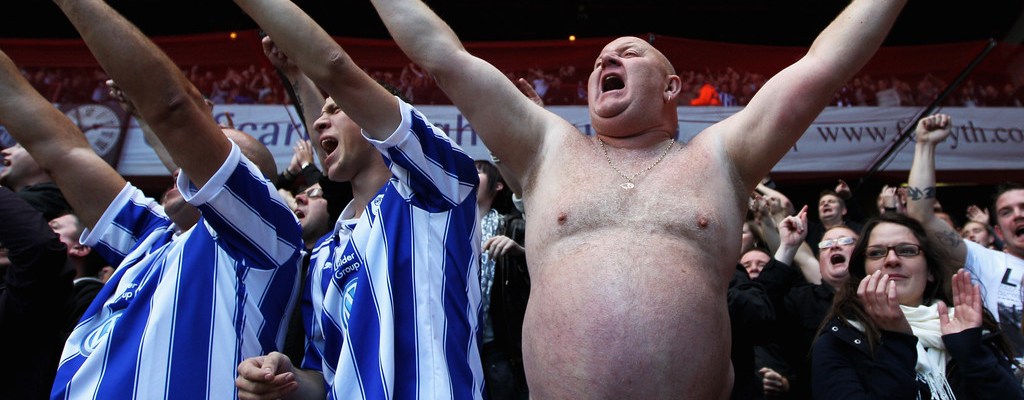
Only 3.7 miles apart, the Steel City derby is one of the fiercest but overlooked derbies of the 20th century, it’s all about two working class teams instigating from Sheffield, the fifth largest city in the United Kingdom.
It’s more than playing for the 3 points, the two teams are playing for the pride of Sheffield, with the only thing lacking from this industrial City being a Premiership team. Football has been preserved in Sheffield’s history, with both sets of fans experiencing the ups and downs of a supporter.
Sheffield Wednesday fans have seen their team going from shining in the 90’s to a struggle in recent years but with the appointment of Steve Bruce, things are looking up.
Sheffield United, however, are a team that have shined during the most recent years and with the Blades currently third in the playoffs, the club seem to be progressing quickly since the club’s promotion from League One during the 2016/17 campaign.
Manager Chris Wilder has certainly had no leg ups and in fact has had a tough ride getting to where he is now, from being appointed manager of Northampton in 2014 who were at the time six points from safety at the bottom of League Two to now becoming one of the best managers in the Championship, there’s no doubt around the terrific job he’s doing at the club with a relatively inexpensive group of players.
The Steel City derby is now at its peak with both teams well earnt of a promotion spot, with the Blades consistency throughout the season and Wednesday’s recent surge up the table since Steve Bruce’s appointment. Will the Steel City derby soon be a Premier League fixture? both clubs certainly have the fan bases, talent and managerial backing to prove themselves in the top flight.
The first player to score for both teams in a Steel City derby was Irishman Alan Quinn, the versatile midfielder scored for Wednesday in their 3-1 defeat to Sheffield United at Bramall Lane in February 2003 and then for the Blades in a 1-0 win at Bramall Lane on the 4th December 2005 after joining them from Wednesday in 2004.
However, The Irishman’s career was ruined by injury after suffering from a groin injury and subsequent infection after an initial good start to the season at his final club Ipswich Town who he signed for in 2008, he was released in 2011. After his release, his career went downhill where he went on to play for Handsworth Parramore in the Northern Counties East Football League. He remains the only player to score for both teams in the Sheffield derby.
The two teams first met on the 15th December 1890 at the home of the Wednesday, Olive Grove, the Wednesday who were later to be named Sheffield Wednesday were playing a friendly against the newly formed Sheffield United, Wednesday won 2–1. Since then, the teams have met competitively a total of 144 times, with Sheffield United leading the way with 46 wins to Wednesday’s 42 and 43 draws.
The latest meeting was the 131st Steel City derby, it was played on the 4th March 2019 at Sheffield Wednesday’s home of Hillsborough Stadium, the game ended 0-0, after both teams were presented with a lack of chances and forming a typically cagey affair, which only saw two chances coming from United’s Gary Madine and Wednesday’s Sam Hutchinson.
How did the rivalry begin?
The rivalry began after Sheffield Wednesday left their home at Bramall Lane due to a dispute over rent and to ensure that there would be no lost revenue, the Cricket committee took the decision to form another football club, and thus Sheffield United were born and Bramall Lane subsequently became their home. The first ever Steel City derby took place on the 16th October 1893 during the 1893/94 English Division 1 season, the season which saw Sheffield United gain promotion to the first division, the game ended 1-1. Most of the Steel City derbies were played while the two teams were in the top two tiers of English football with only two seasons in the third tier, the 1979/80 and 2011/12 season.
There were rumours that it was the most expensive football game to police during the 2017/18 Championship campaign, a fixture so fierce but regularly forgotten about, that is why it’s in our top 10 of the fiercest football derbies in the UK.
In the two club’s latest meeting, the 0-0 draw on the 4th March 2019. The tensions showed after six arrests were made after trouble at Hillsborough Stadium, trouble started when objects were thrown at Sheffield United defender Jack O’Connell when he was taking a throw-in.
Chief Superintendent Morley stated how a minority of fans had taken the opportunity to throw fireworks, coins, cans and stones after the game with many children being caught up in the trouble.
Due to it being a derby, the police have now designed a strategy to prevent further violence outside the stadium, this involves holding back the away fans until the home fans have dispersed. This can be a useful tool to prevent trouble as you won’t get the home and away fans mixing immediately.
However, overall, I don’t see it being an effective tool to reduce trouble because in my experiences it makes fans even more angry when they are held back, like the Sheffield United fans were showing over social media after the recent meeting in March criticising the police’s “shambolic” handling of supporters.
It also doesn’t deter the fans that label themselves as hooligans or to be in a firm as they will still meet the rival fans after the game, due to one reason only, social media. It acts as a platform for communication between fans to schedule meets in locations not known to the police and therefore it will still happen at football.
It will help reduce ‘general trouble’ at football but it won’t prevent the underground scene of football violence which is protected by digital communication fan chats. A platform that has allowed rival fans to be given precise details on meets such as times and locations, a much more scheduled tactic than the clashes seen in the 70’s and 80’s where ‘mobs’ of fans would just bump into each other at the train station, or outside the stadium or go to rivals pubs. Scenes that are rarely seen on derby day due to the influx in policing at football games along with the introduction of CCTV in public places.
 footballrivalries.video.blog